

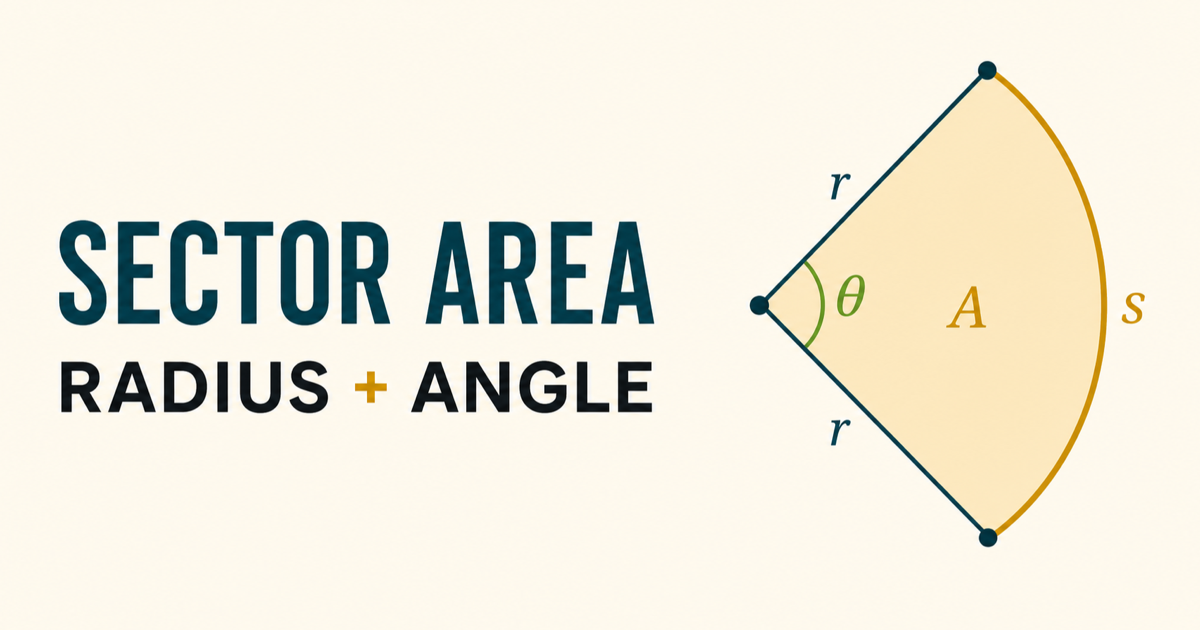
A circular sector is the region swept out by two radii and the arc between them. Once the radius and central angle are known, you can calculate its area, curved edge, and ordinary sector perimeter from the same angle—but only if degrees and radians are handled correctly. This guide derives both formula sets, works a complete example, and explains the boundary checks that keep arc length, sector perimeter, and segment geometry from being mixed together.
Quick answer: sector area, arc length, and perimeter
Let r be the circle radius, θ be the central angle in radians, α be the same angle in degrees, A be sector area, and s be the curved arc length. With a radian angle, the two core relationships are:
Sector area in radians
A = ½r²θSquare the radius, multiply by the radian angle, and divide by two. The result uses a squared length unit.Arc length in radians
s = rθMultiply the radius by the central angle in radians. The result uses the same length unit as the radius.For an ordinary sector with two distinct radial sides—so the angle is greater than 0° and less than 360°—add the two radii to the arc to get its full boundary length:
Ordinary sector perimeter
P = 2r + sThe boundary consists of the curved arc plus two straight radius segments.What a circular sector represents
A sector is a slice of a disk. Its two straight edges are radii that meet at the circle center, and its curved edge is an arc of the circumference. The central angle measures the rotation from one radius to the other. A larger angle selects a larger fraction of the same circle; a larger radius scales both the curved length and the area.
- Radius r is the distance from the center to the circle edge.
- Central angle θ or α is measured at the circle center, not at the circumference.
- Arc length s follows the curved edge and is a linear measurement.
- Sector area A covers the two-dimensional slice and is a squared measurement.
- Sector perimeter P follows the entire boundary: the arc and both radial sides.
A sector is not a circular segment. A segment is bounded by a chord and an arc, with no radius in its boundary. If your drawing shows a straight chord between the arc endpoints, use the Circle Chord & Segment Calculator instead of treating that region as a sector.
Identify the inputs and units before calculating
The direct sector calculation needs a positive radius and a positive central angle. For the common single-turn case, the angle is no greater than 360° or 2π radians. The browser calculator accepts degrees or radians explicitly and keeps the selected length label on its linear and squared outputs; it does not convert a numeric measurement from one length unit to another.
| Quantity | Dimension | Example unit |
|---|---|---|
| Radius r | Length | cm |
| Arc length s | Length | cm |
| Ordinary perimeter P | Length | cm |
| Sector area A | Area | cm² |
| Central angle | Angle | degrees or radians |
Calculate a sector when the angle is in degrees
A degree angle α represents the fraction α/360 of one complete rotation. Apply that same fraction to the full-circle area πr² and circumference 2πr to obtain the sector formulas.
Sector area in degrees
A = (α ÷ 360)πr²Take α/360 of the full disk area. The answer is in the squared unit corresponding to r.Arc length in degrees
s = (α ÷ 360)2πr = πrα ÷ 180Take α/360 of the full circumference, then simplify if useful.After finding s, use P = 2r + s for a sector whose two radial sides are distinct. Keeping the arc as an exact multiple of π until the last display step makes the perimeter easier to audit and reduces early rounding error.
Calculate the same sector in radians
Radians encode the arc-to-radius ratio directly. One complete rotation is 2π radians, so a θ-radian sector occupies θ/(2π) of a full disk. Applying that fraction to πr² simplifies to one half of r squared times θ.
Radian area derivation
A = (θ ÷ 2π)πr² = ½r²θThe π terms cancel, leaving the compact radian form.Radian arc relationship
s = rθThis follows from the radian definition θ = s/r.Area from radius and arc
A = ½rsSubstitute s = rθ into A = ½r²θ. This is a useful independent check when the arc is already known.If your source angle is in degrees, convert it first with θ = απ/180. The result of that conversion is a radian number; only then should it be placed in the compact formulas.
Worked example: radius 9 cm and central angle 80°
Suppose a sector has radius 9 cm and central angle 80°. Because 80/360 reduces to 2/9, the sector is two ninths of the complete disk. The same geometry can be calculated in degrees or after converting the angle to radians.
Convert the central angle
θ = 80π ÷ 180 = 4π ÷ 9 radiansDivide numerator and denominator by 20 to reduce 80π/180 to 4π/9.Calculate sector area
A = ½ × 9² × (4π ÷ 9) = 18π cm² ≈ 56.5487 cm²The exact area is 18π square centimetres; the decimal is rounded to four places.Calculate arc length
s = 9 × (4π ÷ 9) = 4π cm ≈ 12.5664 cmThe factor of nine cancels, leaving an exact curved length of 4π cm.Calculate ordinary sector perimeter
P = 2 × 9 + 4π = 18 + 4π cm ≈ 30.5664 cmAdd both 9 cm radial sides to the curved arc.| Result | Exact form | Decimal form |
|---|---|---|
| Sector area | 18π cm² | 56.5487 cm² |
| Arc length | 4π cm | 12.5664 cm |
| Perimeter | 18 + 4π cm | 30.5664 cm |
Why arc length alone is not sector perimeter
Arc length measures only the curved edge. For an ordinary sector between 0° and 360°, walking the complete boundary also requires travelling along one radius to the center and back out along the other radius. That is why the two straight lengths add 2r.
The 360° endpoint needs separate geometric interpretation. At one full turn, the two radial sides coincide inside the disk rather than forming two distinct outer boundary edges. The region is a complete disk, whose boundary is the circumference 2πr—not 2r + 2πr. Use the Circle Calculator for full-disk area and circumference questions.
Four independent checks for a sector result
- Fraction-of-area check: compare α/360 with the same fraction of πr².
- Fraction-of-circumference check: compare α/360 with the same fraction of 2πr.
- Radius-and-arc check: verify A = ½rs after computing the arc independently.
- Dimension check: area must use a squared unit, while arc and perimeter remain linear units.
For the 9 cm, 80° example, the angle fraction is 2/9. Two ninths of the full area 81π cm² is 18π cm², and two ninths of the full circumference 18π cm is 4π cm. The alternative area relationship gives ½ × 9 × 4π = 18π cm². All three paths agree without reusing the same sequence of arithmetic.
Special angles provide quick reasonableness checks. A 90° sector is one quarter of a disk, a 180° sector is one half, and a 270° sector is three quarters. If those cases do not produce the corresponding fractions, check the angle unit and whether a diameter was entered as a radius.
Common sector calculation mistakes
- Putting a degree value directly into a radian formula.
- Using diameter as r instead of dividing it by two.
- Calling the curved arc alone the complete sector perimeter.
- Adding a chord to the arc and calling the region a sector rather than a segment.
- Reporting sector area in a linear unit instead of a squared unit.
- Mixing length units between the radius and another known measurement.
- Rounding the converted radian angle before calculating area and arc length.
- Treating extra displayed decimals as better measurement accuracy.
- Using the ordinary 2r + s boundary convention for a complete 360° disk.
The formulas describe ideal circle geometry. They do not include material thickness, kerf, manufacturing tolerance, deformation, or safety factors. Preserve the source measurement precision and evaluate those real-world constraints separately.
Calculate the sector in one transparent workflow
Use the free browser Sector Calculator when radius and central angle are known. Enter a positive radius, choose degrees or radians, enter an angle up to one full turn, select the unit label and displayed precision, and compare sector area, arc length, and the calculator’s perimeter output together.
If arc length is the missing value—or if radius or angle must be solved backward—use the Arc Length Calculator. It accepts any two of radius, central angle, and arc length and keeps degree/radian handling explicit. The worked arc-length guide shows that three-value relationship step by step.
On iPhone or Android, Circle Calculator provides a focused sector workflow for radius, angle, area, and perimeter with degree/radian selection. The store buttons below record only an outbound visit. An outbound visit is not counted as an installation, subscription, or purchase, and current availability and purchase terms remain in your device’s store.
Keep the sector with you
Continue in Circle Calculator.
On iPhone or Android, enter a radius and central angle, switch between degrees and radians, and calculate sector area and perimeter in a focused mobile workflow. Current availability and purchase terms appear in your device’s store.