

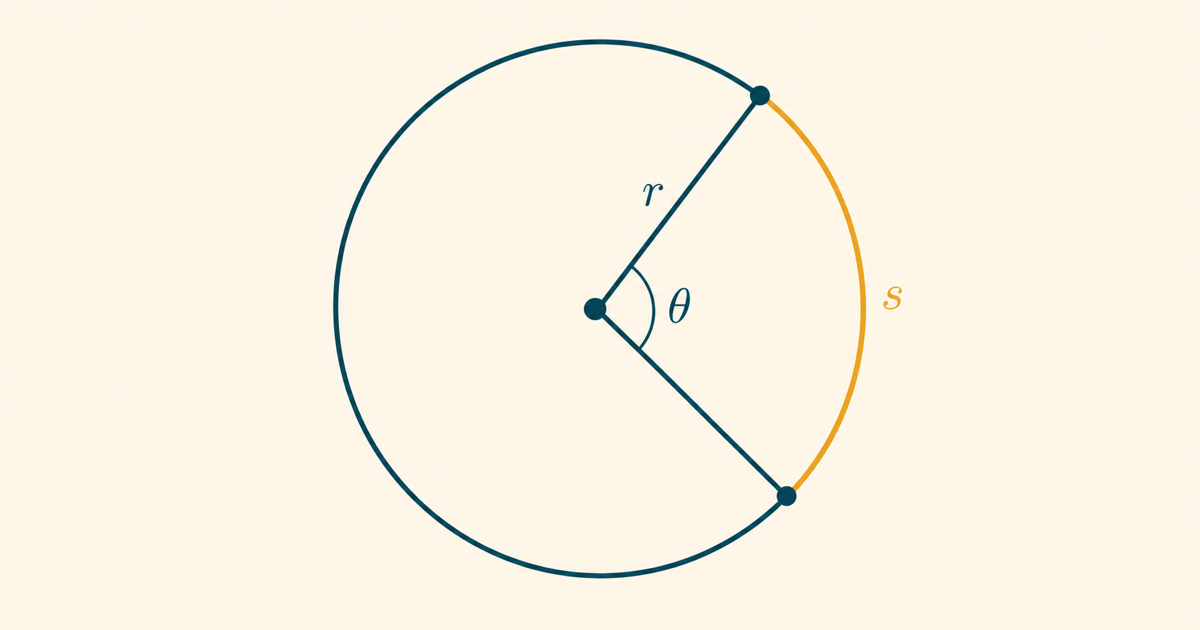
Arc length is the distance along a circle between two radial positions. When you know the radius and central angle, the calculation is direct—but only after you identify whether the angle is in degrees or radians. This guide derives both forms, works an exact example, shows how to solve backward for radius or angle, and gives independent checks that separate a curved arc from its straight chord.
Quick answer: arc length from radius and angle
Let r be the circle radius, s be the arc length, and θ be the central angle measured in radians. The direct arc-length relationship is:
Angle in radians
s = rθMultiply the radius by the central angle in radians. Arc length uses the same length unit as the radius.If the central angle is α degrees, convert it to radians with α × π/180 before multiplying by the radius. Combining those two steps gives a degree-based form:
Angle in degrees
s = πrα ÷ 180Use α as the numerical degree value. Do not insert a degree value directly into s = rθ.What radius, central angle, and arc length describe
An arc follows part of a circle’s circumference. Its endpoints are connected to the center by two radii, and the angle between those radii is the central angle. Increasing either the radius or the central angle makes the arc longer when the other value stays fixed.
- r: the distance from the circle center to the circumference.
- θ: the central angle in radians.
- α: the same central angle expressed in degrees.
- s: the curved distance along the circumference between the two endpoints.
Arc length is not chord length. A chord is the straight segment between the same endpoints and is shorter than the corresponding minor arc except in the limiting case where both approach zero. If your measurement follows the curve, use arc length; if it spans directly across the opening, use the Circle Chord & Segment Calculator.
For a central angle between 0° and 360°, the arc is a positive part of one complete circumference. A 90° angle selects one quarter of the circle, 180° selects one half, and 360° returns the full circumference.
Why s = rθ works with radians
A radian is defined through arc length itself: an angle of one radian intercepts an arc whose length equals the radius. Two radians intercept an arc twice the radius, and so on. That definition is why the radian formula needs no additional conversion factor.
Radian definition
θ = s ÷ rRearrange the definition to s = rθ when radius and angle are known.One complete rotation is 2π radians. Substituting θ = 2π into s = rθ produces s = 2πr, the familiar circumference formula. This is also a useful consistency check: no arc covering at most one turn can be longer than 2πr.
Convert a degree angle before multiplying
Degrees divide a full turn into 360 parts, while radians measure the same turn as 2π. The conversion follows from 360° = 2π radians, or 180° = π radians.
Degrees to radians
θ = α × π ÷ 180Multiply the degree value by π/180, then use the resulting radian value in s = rθ.Combined degree formula
s = r(απ ÷ 180) = πrα ÷ 180The combined form performs the conversion and arc calculation in one expression.There is a second way to see the same relationship. An α-degree arc occupies α/360 of a complete circle, so its length is (α/360)(2πr). Simplifying 2/360 to 1/180 produces πrα/180 again. Reaching the same expression from two definitions helps catch a missing factor of two.
Worked example: radius 12 cm and angle 75°
Suppose the radius is 12 cm and the central angle is 75°. Convert the angle before using the radian formula, or substitute directly into the degree formula. Keep π exact until the final display step.
Convert the angle
θ = 75π ÷ 180 = 5π ÷ 12 radiansDivide numerator and denominator by 15 to reduce 75π/180 to 5π/12.Calculate the arc
s = 12 × (5π ÷ 12) = 5π cm ≈ 15.7080 cmThe factor of 12 cancels, leaving an exact arc length of 5π cm.| Check | Relationship | Result |
|---|---|---|
| Angle fraction | 75 ÷ 360 | 5/24 of a turn |
| Full circumference | 2π × 12 | 24π cm |
| Fraction of circumference | (5/24) × 24π | 5π cm |
| Decimal arc length | 5 × π | 15.7080 cm |
Solve backward for radius or central angle
The same relationship can solve for a missing radius or angle. Start with s = rθ, keep the angle in radians during the rearrangement, and isolate the unknown value.
Radius from arc length and radian angle
r = s ÷ θDivide the arc length by the central angle in radians. Radius and arc length use the same length unit.Radian angle from arc length and radius
θ = s ÷ rThe quotient is the angle in radians because that is the defining radian ratio.Degree angle from arc length and radius
α = 180s ÷ (πr)Convert s/r from radians to degrees by multiplying by 180/π.Use the Arc Length Calculator to choose which value is missing. It supports radius plus angle, radius plus arc, or angle plus arc and keeps degree/radian conversion explicit.
Checks before you use the result
A correct equation can still produce a misleading result when an input unit or geometric reference is wrong. Run at least one independent check before copying the number into another calculation.
- Angle-unit check: label the input as degrees or radians before calculating.
- Length-unit check: make sure every radius or arc measurement uses one consistent length unit.
- Circumference bound: for 0° < α ≤ 360°, require 0 < s ≤ 2πr.
- Fraction check: compare α/360 with the same fraction of the full circumference.
- Special-angle check: 90°, 180°, and 360° should produce πr/2, πr, and 2πr respectively.
- Direction check: arc length is a nonnegative distance; clockwise versus counterclockwise affects orientation, not the magnitude for the same swept angle.
If your boundary is a sector rather than only its curved edge, arc length is not the complete answer. The Sector Calculator returns sector area and adds both radii to the arc when calculating the full sector perimeter.
Common arc-length mistakes
- Putting degrees directly into s = rθ. That formula expects radians.
- Using diameter where the formula expects radius. Divide the diameter by two first.
- Confusing the curved arc with the straight chord between its endpoints.
- Using πr², which is an area formula, instead of the circumference relationship.
- Dropping the factor of two when checking against the full circumference 2πr.
- Mixing millimetres, centimetres, or inches between radius and arc length.
- Rounding the converted angle before multiplying. Keep extra digits and round the reported length last.
- Treating displayed decimal places as measurement accuracy. Output precision cannot improve the source measurements.
Also confirm that the central angle is measured at the circle center. An angle drawn at the circumference is an inscribed angle and follows a different relationship. The two rays defining a central angle must begin at the same center point as the radius.
Calculate an arc and keep the scope clear
Use the free browser calculator when you want a transparent calculation without an account. Select the missing value, enter the two known values, choose degrees or radians, and set the displayed precision. The result remains an ideal geometric length, so real fabrication, material, tolerance, or safety requirements still need their own inputs and review.
For a full-circle cross-check, the Circle Calculator derives circumference from radius or diameter. Compare the arc to that circumference whenever the angle represents no more than one full turn.
Circle Calculator carries the same three-value arc workflow to iPhone and Android: enter any two of radius, central angle, and arc length, choose degrees or radians, and solve the missing value. The store buttons below record only an outbound visit. An outbound visit is not counted as an installation, subscription, or purchase, and current availability and purchase terms remain in your device’s store.
Keep the curve with you
Continue in Circle Calculator.
On iPhone or Android, enter any two of radius, central angle, and arc length, switch between degrees and radians, and solve the missing value. Current availability and purchase terms appear in your device’s store.