

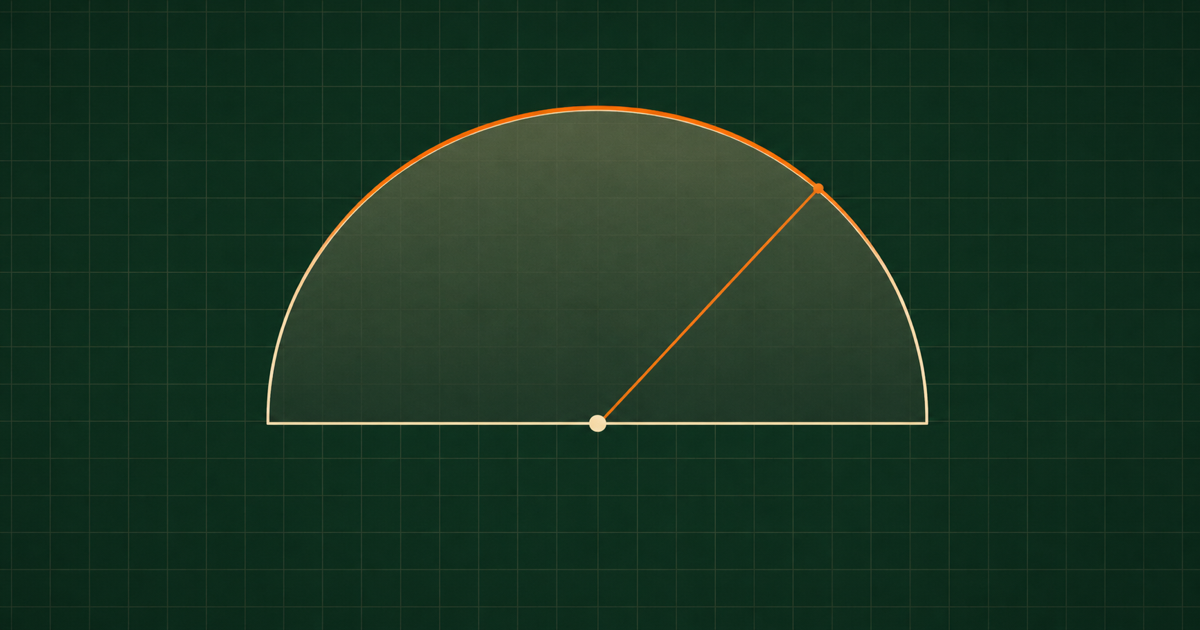
A semicircle is half of a disk, but its full perimeter is not simply half of a circle's circumference. The boundary includes both the curved half-circle and the straight diameter. This guide separates area, curved arc length, and full perimeter; gives equivalent radius and diameter formulas; works one complete example; and shows independent checks that catch the most common boundary and unit mistakes.
Quick answer: semicircle formulas from radius or diameter
Let r be radius, d be diameter, A be semicircle area, L be only the curved arc length, and P be the full closed perimeter. Because d = 2r, the radius and diameter columns below describe the same half-circle.
| Quantity | From radius r | From diameter d |
|---|---|---|
| Area A | A = πr² ÷ 2 | A = πd² ÷ 8 |
| Curved arc L | L = πr | L = πd ÷ 2 |
| Full perimeter P | P = πr + 2r | P = πd ÷ 2 + d |
Area, arc length, and perimeter answer different questions
A semicircle has one two-dimensional measurement and two useful boundary measurements. Confusing them can produce an answer with the right-looking number but the wrong physical meaning. Decide which part of the shape the task asks for before selecting a formula.
- Area A measures the shaded half-disk and uses squared units such as cm², m², or in².
- Curved arc length L measures only the rounded edge and uses a linear unit such as cm, m, or in.
- Full perimeter P follows the entire closed boundary: the curved arc plus the straight diameter.
- Diameter d is the straight edge of the semicircle and equals two radii.
If a design needs trim only along the curved edge, use L. If fencing, edging, a frame, or a closed outline follows both the curve and the flat edge, use P. Area cannot be added to either length because squared and linear units describe different dimensions.
Calculate a semicircle from radius
Radius is the most direct input. Start with the full circle formulas, take one half for the disk area and circumference, then add the diameter only when the complete semicircle perimeter is required.
Semicircle area from radius
A = πr² ÷ 2A full disk has area πr², so a diameter cut divides that area into two equal halves.Curved arc from radius
L = πrThe full circumference is 2πr; the 180° arc is exactly half, which is πr.Full perimeter from radius
P = πr + 2r = r(π + 2)Add the curved length πr to the straight diameter 2r to close the boundary.Keep π unrounded during the calculation. If r is measured in centimetres, L and P are in centimetres while A is in square centimetres. Round only the final displayed values so all three results still describe one consistent shape.
Calculate a semicircle from diameter
When the straight side is known, that measurement is the diameter. You may divide by two to recover radius and then use the radius formulas, or use the equivalent diameter forms directly. Both paths must give the same result.
Semicircle area from diameter
A = πd² ÷ 8Substitute r = d/2 into πr²/2: squaring the half introduces a factor of four, and halving area introduces another factor of two.Curved arc from diameter
L = πd ÷ 2The full circumference is πd, so the curved half is πd/2.Full perimeter from diameter
P = πd ÷ 2 + d = d(π ÷ 2 + 1)Add the straight diameter d to the curved half-circumference πd/2.Do not square the diameter and divide by only two for area. The correct diameter formula divides πd² by eight because d must first be halved to become radius before the radius is squared.
Worked example: a semicircle with a 20 cm diameter
Suppose the straight edge of a semicircular piece measures 20 cm. This is the diameter, so the radius is 10 cm. Preserve the exact π forms until the final decimal values.
Recover radius
r = d ÷ 2 = 20 ÷ 2 = 10 cmThe center divides the 20 cm diameter into two equal radii.Calculate area
A = π(10)² ÷ 2 = 50π cm² ≈ 157.0796 cm²Square the 10 cm radius, multiply by π, and take half of the full disk area.Calculate curved arc
L = π(10) = 10π cm ≈ 31.4159 cmThe rounded edge is half of the full 20π cm circumference.Calculate full perimeter
P = 10π + 20 cm ≈ 51.4159 cmAdd the 20 cm straight diameter to the 31.4159 cm curved arc.| Result | Exact | Decimal |
|---|---|---|
| Area | 50π cm² | 157.0796 cm² |
| Curved arc | 10π cm | 31.4159 cm |
| Full perimeter | 20 + 10π cm | 51.4159 cm |
Independent checks for a semicircle result
A reliable check uses a relationship different from the calculation path. The 20 cm example gives several quick tests that do not require repeating every original step.
- Double the semicircle area: 2 × 50π = 100π cm² ≈ 314.1593 cm², which equals the full disk area π(10)².
- Double the curved arc: 2 × 10π = 20π cm ≈ 62.8319 cm, which equals the full circumference 2π(10).
- Subtract the arc from the full perimeter: (20 + 10π) − 10π = 20 cm, which recovers the diameter.
- Check dimensions: the area result uses cm², while arc length and perimeter use cm.
Recover radius from area, arc length, or perimeter
Some drawings provide a semicircle area, curved edge, or complete perimeter instead of radius. Invert the matching formula first, then derive diameter and the remaining measurements from the recovered positive radius.
Radius from semicircle area
r = √(2A ÷ π)Multiply A = πr²/2 by two, divide by π, and take the positive square root.Radius from curved arc
r = L ÷ πUndo the multiplication by π in L = πr.Radius from full perimeter
r = P ÷ (π + 2)Factor P = πr + 2r into r(π+2), then divide by the full coefficient.After recovering r, set d = 2r. Confirm that the supplied value was truly a semicircle measurement: using an arc-only value as P, or a full-circle area as A, produces a different shape even if the algebra is performed correctly.
Why a semicircle is a 180° sector
A complete turn is 360°. A semicircle uses a 180° central angle, exactly one half of the turn. The general sector formulas therefore reduce to the semicircle formulas without needing a separate geometric rule.
Semicircle as half of a full disk
A = (180° ÷ 360°)πr² = πr² ÷ 2The area fraction equals the central-angle fraction: 180/360 = 1/2.Semicircle as half of a full circumference
L = (180° ÷ 360°)2πr = πrThe same one-half ratio applies to the curved boundary, but not to the added straight diameter.Common semicircle area and perimeter mistakes
Most errors come from selecting the wrong boundary, treating diameter as radius, or applying the one-half factor in the wrong place. Write the known symbol and requested result before substituting a number.
- Reporting πr as the full perimeter. It is only the curved arc; add 2r for the straight diameter.
- Using πd²/2 for area. Diameter must be halved before squaring, so the correct result is πd²/8.
- Halving the radius because the shape is half a circle. The semicircle has the same radius as its parent circle.
- Adding a length to an area. Perimeter and arc use linear units; area uses squared units.
- Rounding π or radius during intermediate steps, which can make the checks disagree unnecessarily.
Calculate and verify a semicircle in one workflow
Use the free browser Sector Calculator with a positive radius and a 180° angle. Read sector area as the semicircle area, arc length as the curved edge, and sector perimeter as the complete boundary made from the arc and two collinear radii.
If only diameter, full circumference, or full-circle area is known, first use the Circle Calculator to recover radius. For a separate check of the curved part, use the Arc Length Calculator with radius and 180°. Keep the same unit and final precision across all results.
On iPhone or Android, Circle Calculator offers focused circle, sector, and arc workflows. The store buttons below record only an outbound visit. An outbound visit is not counted as an installation, subscription, or purchase, and current availability and purchase terms remain in your device's store.
Check the half-circle
Continue in Circle Calculator.
Use the sector workflow on iPhone or Android with a 180° central angle to evaluate semicircle area, arc length, and boundary measurements. The store buttons record only an outbound visit; that is not an installation, subscription, or purchase. Current availability and purchase terms appear in your device's store.