

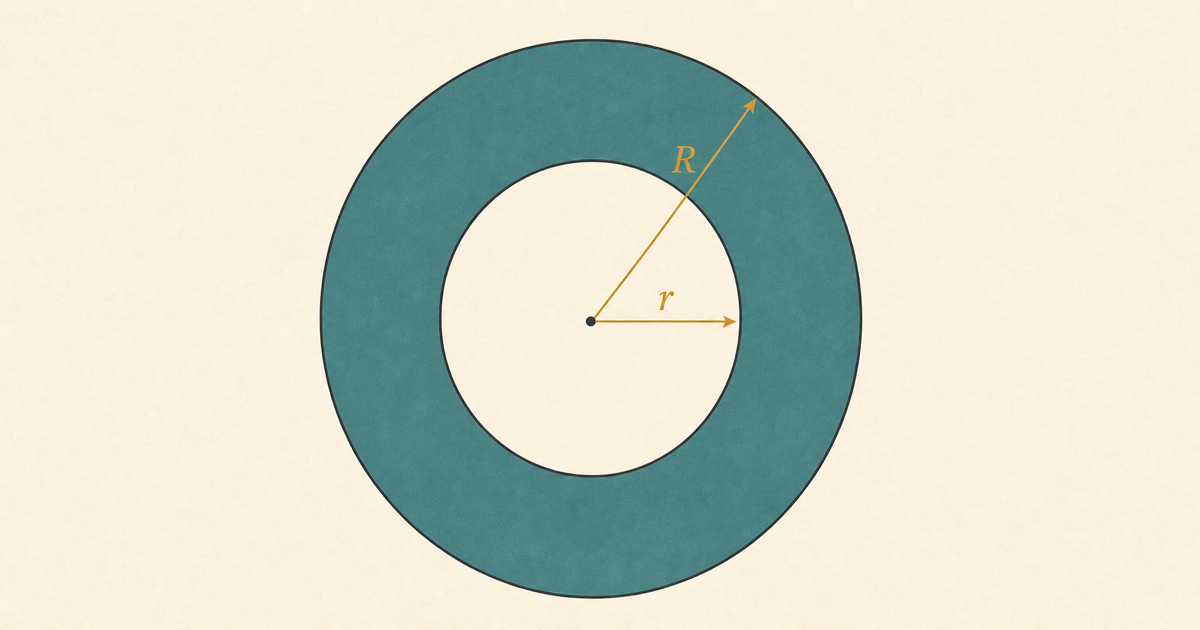
A flat ring is the area left when a smaller concentric circle is removed from a larger one. If a drawing gives you the outer diameter and inner diameter, this guide shows how to convert those measurements, subtract the two circle areas, verify the result, and avoid the radius-versus-diameter mistake that changes the answer by a factor of four.
Quick answer: ring area from two diameters
Let D be the outside diameter and d be the inside diameter. For two circles that share the same center, the flat area between them is:
Annulus area from diameters
A = (π ÷ 4)(D² − d²)Square each diameter, subtract the inner square from the outer square, then multiply by π/4.You can also halve both diameters first. The outer radius is R = D/2 and the inner radius is r = d/2, giving the equivalent formula A = π(R² − r²). Both methods produce the same area when the inputs use the same length unit.
What an annulus is
An annulus is the two-dimensional region between two concentric circles. Concentric means that the circles have exactly the same center. The larger circle supplies the outside boundary; the smaller circle supplies the edge of the central opening. The highlighted band in the diagram is the annulus.
The word ring is often used informally for the same flat shape. A flat washer face, an idealized pipe cross-section, or a ring-shaped path can be modeled this way when the two boundaries are circular and concentric. The formula describes only the flat face. It does not calculate thickness, volume, mass, cost, strength, or manufacturing allowance.
- D: outer diameter, measured across the complete outside circle through its center.
- d: inner diameter, measured across the central opening through the same center.
- R: outer radius, equal to D ÷ 2.
- r: inner radius, equal to d ÷ 2.
- A: the flat area between the two circular boundaries.
If you need to check an individual diameter or circle area before subtracting, the Circle Calculator shows the radius, diameter, circumference, and area relationships for one circle at a time.
Why the annulus formula works
Start with the area of the complete outer disk, πR². The central opening would occupy πr² if it were filled. Removing that inner disk leaves the band, so subtract the two areas—not the two radii.
Subtract the inner disk
A = πR² − πr² = π(R² − r²)Factor out π after calculating the two squared radii.To write the same relationship with diameters, substitute R = D/2 and r = d/2. Squaring each fraction introduces a factor of one quarter: (D/2)² = D²/4 and (d/2)² = d²/4.
Convert the radius formula to diameters
A = π(D²/4 − d²/4) = (π/4)(D² − d²)The diameter form is useful when both measurements come directly from a drawing or caliper reading.Worked example: 50 mm outside, 30 mm inside
Suppose a flat concentric ring has an outside diameter of 50 mm and an inside diameter of 30 mm. The outer radius is 25 mm and the inner radius is 15 mm. Keep the exact π expression until the last step so early rounding cannot accumulate.
Substitute the two diameters
A = (π/4)(50² − 30²) = (π/4)(1600) = 400π mm²The exact area is 400π mm²; using π numerically gives approximately 1256.6371 mm².| Measurement | Relationship | Result |
|---|---|---|
| Outer radius | 50 ÷ 2 | 25 mm |
| Inner radius | 30 ÷ 2 | 15 mm |
| Ring area | π(25² − 15²) | 1256.6371 mm² |
| Radial width | (50 − 30) ÷ 2 | 10 mm |
| Outer circumference | π × 50 | 157.0796 mm |
| Inner circumference | π × 30 | 94.2478 mm |
Find radial width and both circumferences
Area is not the only useful result. Radial width is the straight distance from the inner boundary to the outer boundary along any radius. It is the difference between the radii, which is half the difference between the diameters.
Radial width
w = R − r = (D − d) ÷ 2This is a one-sided radial distance, not the full difference across both sides of the ring.The ring also has two separate circular edge lengths. The outside circumference is πD, and the inside circumference is πd. If someone asks for the total boundary length of the flat annulus, add those two circumferences and state clearly that both boundaries are included.
Circular boundary lengths
Couter = πD · Cinner = πdBoth circumference results use the original length unit, unlike area, which uses the squared unit.The free Annulus & Ring Area Calculator returns area, radial width, and both circumferences together. Choose diameter mode when your source measurements are OD and ID so you do not have to halve them manually.
Four ways to verify a ring-area result
A second check is especially useful when a value will be copied into a drawing, estimate, or spreadsheet. These checks test different parts of the setup rather than merely pressing the same calculator keys twice.
- Radius check: confirm that R = D/2 and r = d/2 before squaring anything.
- Two-disk check: calculate πR² and πr² separately, then subtract the smaller area from the larger.
- Bounds check: the ring area must be positive and smaller than the complete outer-circle area.
- Width check: confirm that 2w + d = D. For the example, 2(10) + 30 = 50 mm.
You can also test limiting cases. If the inner diameter approaches zero, the result approaches the full outer-disk area. If the inner diameter approaches the outer diameter, the ring becomes very narrow and its area approaches zero. A result that moves in the opposite direction indicates a reversed input or an incorrect subtraction.
Common annulus calculation mistakes
- Using a diameter in a radius formula. Either halve both diameters or use the diameter formula with its π/4 factor.
- Entering the inside measurement as the outer size. The outer diameter must be strictly larger than the inner diameter for a nonzero ring.
- Mixing units. Convert both inputs to one unit before subtracting or squaring them.
- Subtracting radii and treating the difference as area. R − r is radial width, not ring area.
- Calculating (D − d)² instead of D² − d². These expressions are not interchangeable.
- Calling one circumference the perimeter without stating which edge it follows. A ring has both an inner and outer boundary.
- Rounding radii before the area calculation. Keep full precision through the squares and round only the reported result.
Measurement uncertainty still matters. Squaring an uncertain diameter can magnify its effect on the area. Report a number of decimal places supported by the original measurements rather than assuming that a long calculator display makes the physical dimensions equally precise.
Use the formula for the right shape
This method assumes an ideal flat annulus with circular, concentric boundaries. It is a useful preliminary geometry calculation for ring-shaped layouts, flat washer faces, and circular cross-sections. An off-center opening, an elliptical boundary, or an irregular cutout needs a different geometric model.
The area alone is not a material quantity or production specification. Turning it into volume requires a verified thickness; turning volume into mass requires material density. Real work may also need kerf, tolerances, coatings, deformation, standards, or professional review. The annulus formula does not decide those requirements.
Use the browser calculator to verify the relationship without an account, then compare the exact form and the rounded display. Circle Calculator offers the corresponding inner-radius and outer-radius workflow on iPhone and Android, including area, width, two circumferences, and a measured annulus diagram. If your source gives diameters, divide each by two before entering the mobile values. Store buttons below are measured as outbound visits only; an outbound visit is not treated as an installation or purchase.
Take ring geometry with you
Continue in Circle Calculator.
Calculate annulus area from inner and outer radii on iPhone or Android, with ring width, both circumferences, and an annulus diagram in the same workflow. If you measured diameters, divide each by two before entering them. Current availability and purchase terms appear in your device’s store.